Coaching & Consultancy

I offer here some of the frames in which I locate my thinking and action in coaching and consultancy work, and throughout the professional learning and training I offer. I am aware of how a consideration of a ‘theory of change’ and how, in terms of mechanisms or processes that enable changes in practice, thinking and behaviour to occur are often considered as essential requirements for transformational practices such as coaching, consultancy and professional development. I offer here 3 themes that frame my work and thinking in this area that have been challenged by 2 questions (that I have slightly paraphrased here) posed by Nora Bateson (2022) in her research paper, “An essay on ready-ing: Tending the prelude to change.”
The 2 questions are:
1. What if, instead of thinking of a theory of change being produced from an identified preferred goal or outcome, the focus instead was placed on the way in which a system (such as a school or early years setting) becomes ready for undetermined and/or multiple possibilities of change?
2. Can this ready-ness be nourished, and how?
Nourishing Freshest Thinking
Opportunity to think about what we do when we are all busy doing it is hard! We know that for children, enabling them to think about their own learning and understanding enables them to learn more effectively and more deeply (Claxton, 2018) and it’s the same for adults too. Kline (1999) refers to our ‘freshest thinking’ that comes to us as we pause and reflect. It enables new ideas to rise and bubble up, new connections to be forged and thus leads to new ways of thinking and working in which innovation and new learning can occur. But it needs to be fed through the practice of thinking together with others so that diversity and difference in experiences, contexts and perspectives can inform our thinking. This is why reflecting on practice and the policies, ethos and assumptions that frame it is at the heart of being able to do our ‘freshest thinking’ (Kline, 1994).
Nourishing Thinking Environments & Thinking with Materials
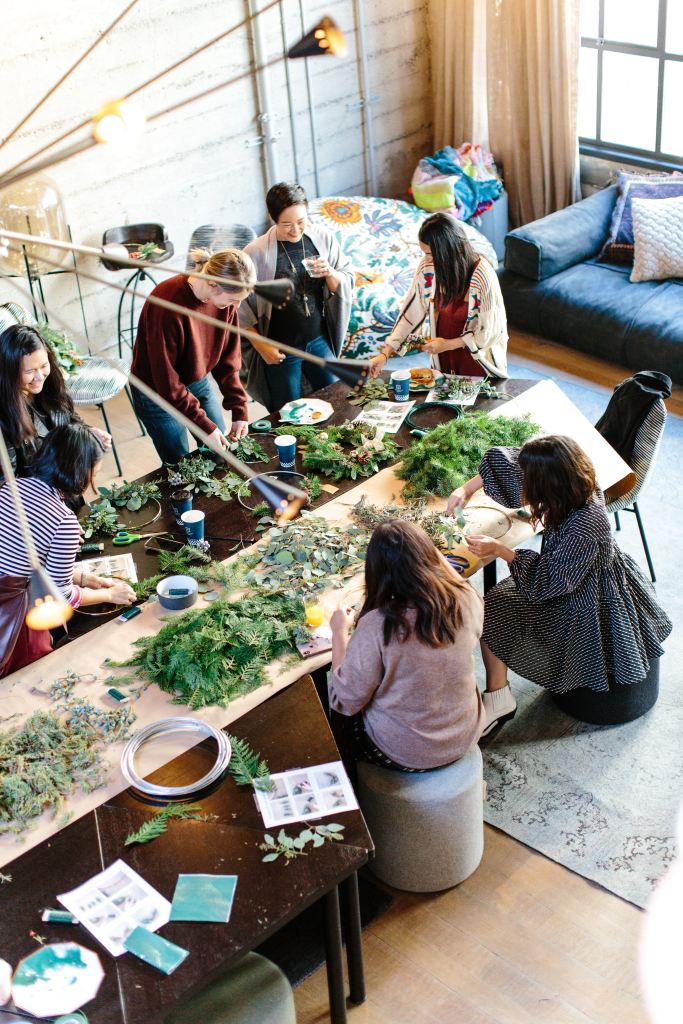
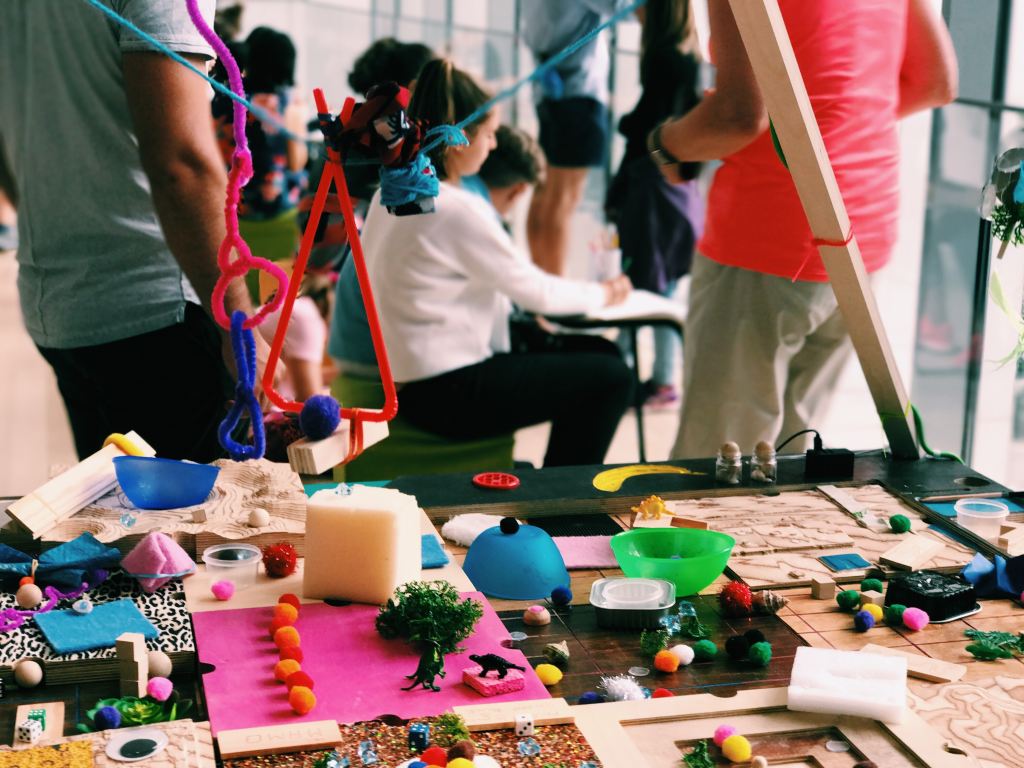
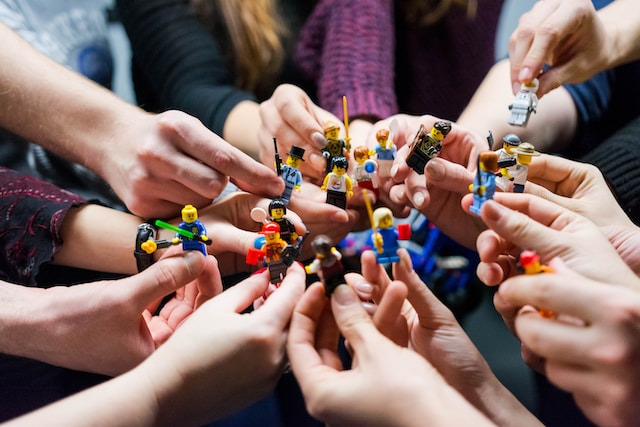
Sometimes the hardest part of thinking together are the conditions in which we do it. I am not talking fancy hotels, lavish food, and scenic views here (although nice!) I am talking about the generative environments and provisions that enable rich, deep, and inclusive thinking about practice, pedagogy, curriculum, and the relationship between the impact of teaching and the outcomes of children’s learning. I use materials and media (just like we do with young children) to enable educators and teams to play around with their ideas through ‘thinking with materials’ (Ketchabaw, Kind and Kocher, 2017). I know that young children are very capable of this as they play and inquire, making connections, meaning, and formulating working theories (Hedges, 2022) to test out, reason and communicate their own thinking. Re-kindling as adults our sensitivity to ‘thinking with and through materials’ whether that is by drawing, Lego, loose parts or found and natural materials helps us all to recognise how materials and media are more than available choices for children within continuous provision but are materials and languages of learning which give shape, form and context to thinking about and exploring abstract ideas (Gallas, 1994). Another component that contributes to a rich thinking environment includes creating a physical and safe space for dialogue and activity that says back to educators that their ideas and they themselves really do matter (Kline, 1994).
Ready-ing for Change
Change happens, and seems quite predictable in its occurrence – but how does it happen? This seems to be the platinum question at the heart of a theory of change – what strategy, process, mechanism, or input? It all sounds rather industrial and mechanised when thinking about how human beings learn. Change happens and we do it often without thinking about it, slipping into old habits, the effects of passing of time, or going along with the flow of popular opinion. All living things adapt and evolve and thus a living organisation, such as a school, is a living system of constant learning, unlearning, modification and reorganisation at many complex levels and intersections. Ignoring the complexity is a fundamental flaw of trying to perceive where that living organisation has become stuck and to develop any kind of action to become unstuck, as trying to change just one element will create a counter kick in the system elsewhere (Bateson, 2016). Nora Bateson challenges the idea of sustainable change within any kind of linear process and suggests that the questions asked about which mechanisms produce change are deeply problematic (Bateson, 2022). She describes the necessity of learning to be in new ways as an approach to the vitality of life rather than as a fixed and guaranteed methodology of sustained change. Is any change fixed, or is change always shifting and transforming? She describes instead this process of ‘ready-ing’ which is the often ignored prelude to what makes actual change possible. It requires zooming in to explore the details of any situation, but also zooming out to consider that issue in how it fits with the whole and interrelates to wider systems and contexts. It involves learning to think differently and engaging with new perspectives and ways of looking to be able to perceive differently. Einstein’s famously attributed quote that ‘we cannot solve our problems with the same thinking we used to create them’, is relevant here “. It means then we need to ready ourselves by engaging in multiple perspective approaches, and attending to the potentials of change through complexity-informed evaluation in what emerges through reflective practices (Bateson, 2022). And finally, it requires increasing our sensitivities and attention to the shifts in perception and action that occur, rather than fixating on the protocols and strategies that try to force change to occur. The ready-ing in relation to the potentials and possibilities of change must grow in the conditions it needs, and cannot be forced (Bateson, 2022).
Have an idea in mind?
 Debi Keyte-Hartland